I’m giving up on cabbages.
I am also abandoning cauliflowers.
Both continually disappoint in my garden.
This year the cabbages seemed to be doing really well. I grew them under netting which was very successful in keeping them free from caterpillars. However, when the cabbage moth couldn’t spoil the crop, the slugs “stepped” in to take their place. And earth worms haven’t helped either. Both have made their home between the leaves. It’s impossible to use the cabbage without removing each leaf separately to pick off the slugs and worms, this really spoils the appetite.
Instead of wasting more time and garden space on leafy veg failures, I’ll stick with things that do well. This year we tried Kale for the first time. It crops prolifically a short time after planting and it provides a very worthwhile alternative to cabbage.
We’ll also stick with broccoli. The netting idea has helped prevent last years problems in which the broccoli heads were infested with caterpillars. The net keeps away the butterflies, preventing them laying their eggs on the veggies, therefore keeping them free from caterpillars. I’m not sure what type of plants we used this year, but the broccoli heads are massive – dinner plate size – and the smaller side shoots which are usually broccolini-like, are more the size of the normal broccoli heads sold in the supermarket.
Thursday, October 07, 2010


Friday, October 01, 2010
The Alternative Kitchen Garden an A-Z

I’ve tried a few times to start this review but haven’t been happy with any of my attempts so far. So I decided to stop trying any “cleverness” and to come to the point. The Alternative Kitchen Garden an A-Z is an excellent book.
It is a joy to read, it is informative, encouraging and entertaining. It can be read one topic per sitting if time is short, or if circumstances and several free hours permit it could easily be read from cover to cover with barely a break.
Emma Cooper is an enthusiastic amateur gardener sharing her experiences and discoveries. Many gardening books have left me discouraged, making the garden seem like an alien environment needing detailed technical knowhow and abundant finances to maintain. This book helps make a successful garden seem more attainable.
There are sections covering many gardening related topics arranged in alphabetical order. A quick count reveals around 150 separate topics are covered. Different kinds of vegetables, garden pests, soil conditions, gardening practices, environmental issues and helpful resources are all touched upon in sufficient, but not overwhelming detail, most of them across two pages.
Cooper seems to have a particular interest in trying the unusual, from exotic fruit and veggies to using a Grow Dome instead of a traditional green house, but this does not distract from more common and widely familiar plants and gardening experiences.
While many readers wouldn’t see the need to grow Quamash (”an edible bulb, a staple food of native Americans”) or Tiger Nuts (an edible tuber related to papyrus), Cooper still makes them interesting topics to show we don’t need to stick to the common and predictable within the garden. Experimentation and discovery can add a new dimension of interest and maybe extend our diet beyond the handful of familiar veggies we tend to stick with.
The Alternative Kitchen Garden is a very personal account of gardening, and as the title indicates it relates mainly to the growing of edibles. I’ve wanted to increase the productiveness of my own garden by incorporating more food producing plants and I appreciate the help and inspiration this book provides.
For a very good idea of what the book’s content I recommend a listen to some of the Alternative Kitchen Garden (AKG) podcasts. The link will be provided below.
The podcast was my introduction to Emma Cooper. Her short broadcasts, and now her book, have been very helpful for my own gardening journey. Somehow she manages to discover and share basic information that the gardening “experts” somehow forget to tell us.
Before I discovered AKG I had been puzzled by the round garlic-lie balls that had grown in my garden. These I found are the product of bulbils, tiny cloves that grow on soft-neck garlic. If left in soil they grow into the single balls of garlic that I had found. When these balls are left a further year (or when replanted) they form into the more familiar segmented heads of garlic cloves.
Link to The Alternative Kitchen Garden Podcast:
http://coopette.com/akg
.
Monday, September 13, 2010
Asparagus and a fine weekend
 It is now the start of the third year the after planting of our two asparagus crowns and we have reaped our first harvest. The total first crop is illustrated in the accompanying photo.
There is another spear on the way, but it’s not quite ready to cut. Hopefully it will be ready soon enough to prevent arguments over who gets to eat. A second spear would at least give us one each.
Saturday and Sunday were the first fine weekend we’ve had for some time and I was able to get a few things done. However I didn’t get round to weeding a narrow garden alongside our boundary fence. It is getting quite overgrown with a healthy crop of low growing weeds. If only the veggies thrived as well.
Maybe I’ve been bit too optimistic, but I planted out two Roma tomato plants. I’ve given them a little protection with plastic guards in case we get another frost. One of the unfortunate things of our location is the unexpected frosts, which often come in October and even into November. So any planting of frost tender plants has an element of risk. But the alternative is leaving planting until very late Spring or early summer.
I also sowed seeds into a few punnets.
I’ve had very little success with growing from seed. In the past pumpkin, Zucchini and beans have done very well. Onions have also succeeded. But everything else has been very hit and miss. On Saturday I sowed some Rhubarb and Asparagus as well as some ornamentals: Penstemon, Larkspur and California poppies. To (hopefully) improve their chances I’ve placed them in a temporary “green house” made out of an upturned plastic storage box.
It’s now been a couple of weeks since the shed was built and I’ve moved the mower, mulcher and kettle barbecue into it. That has given me a lot more room in the garage. I haven’t totally solved the problem of the leaks, but I have an idea where some of the water has been getting in and I’ll attempt to fix that before too long.
I did notice one little pool of water yesterday that had no logical source. I checked all around the concrete outside the shed, I checked the walls, and the roof and the pool seemed to have no source. The only conclusion I can draw is that it’s coming up out of the floor itself.
Friday, September 10, 2010
Reviewing The Shed
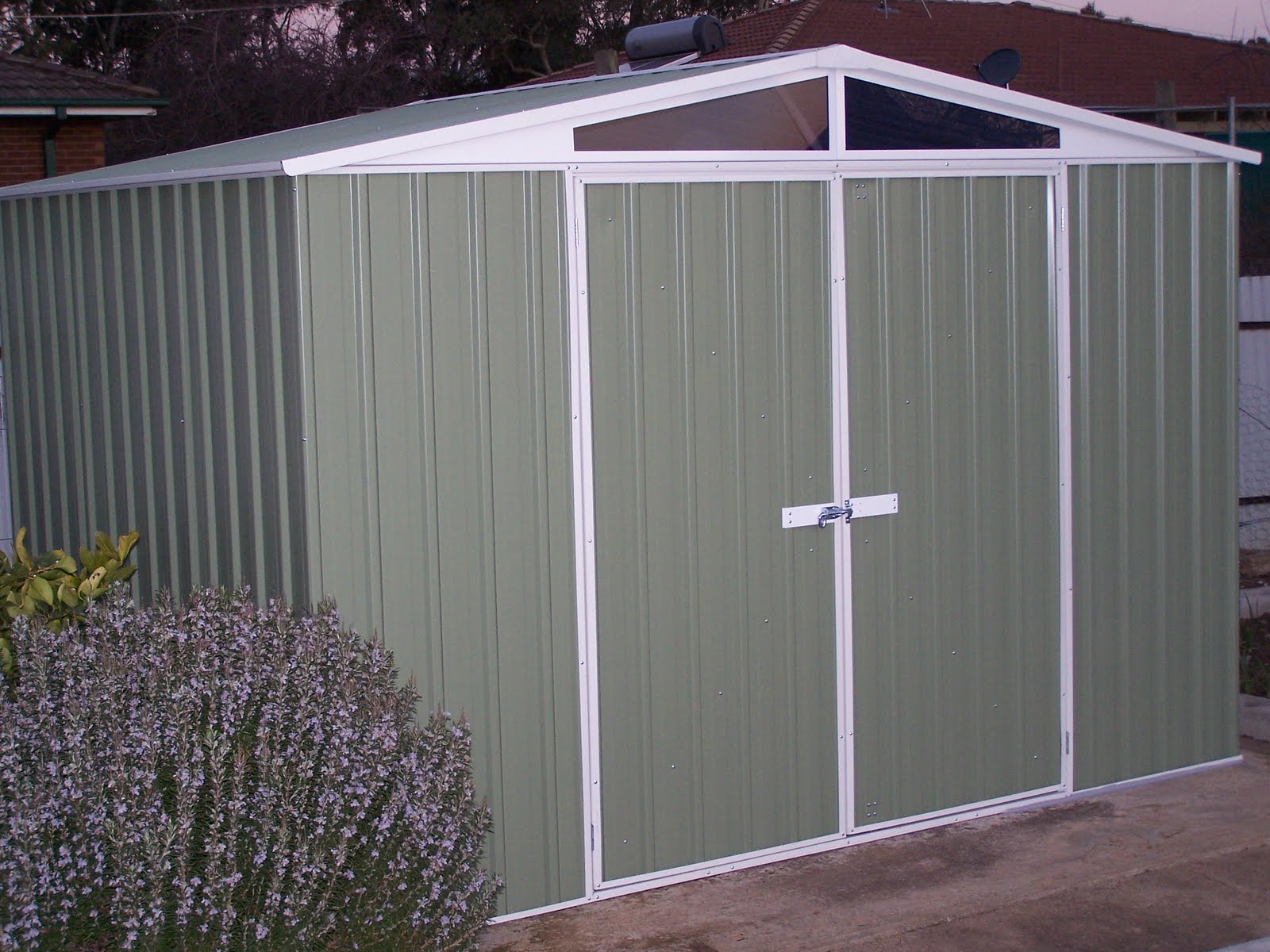 Before buying a book a CD or a DVD, or before seeing a movie, we can refer to reviews to get an idea of whether it suits our tastes and requirements. There are even reviews of restaurants and wines which can help us make informed choices. But as far as I know, similar resources are not available to help us choose a significantly more expensive and long lasting item - a garden shed.
One thing we overlooked when we bought our house was its lack of storage, and in particular outside storage. For four years our gardening equipment has been taking up room in the garage, at times making movement around the garage difficult.
A few weeks ago, after considering a lot of different options, we were seduced by a glossy advertising leaflet that came with the junk mail. Several different sheds were offered at sale prices. One looked particularly attractive, was the right size and came with a window panel. It also had a 20 year warranty. It looked to be exactly what we were looking for so we placed an order.
A week later the kit was delivered and we arranged for a suitably skilled friend to assemble it. Last Friday he came around, and when I got home from work the shed was finished – but what a disappointment.
1) The paperwork with the shed said the warranty was 12 years and not the 20 years in the leaflet (which we no longer have).
2) The panels were joined together with self-tapping screws, which mostly had their sharp points exposed inside the shed.
3) There were a couple of sharp edges exposed on the door.
4) The next morning the inside walls and roof were dripping with condensation.
5) Despite sealing all around with silicone, after the weekend’s heavy rain the floor inside was soaked. We were able to remove half a bucketful of water.
When I consider the cost of the shed alongside the disappointing product, for not much more I could have had a much more suitable and efficient shed custom built.
Thursday, August 26, 2010
End of Neglect?
Over winter the garden has been a little neglected. This has been reflected in the lack of gardening content on this blog. Now winter is coming to a close but its last effects remain.
We’ve had only five rain free days this month (and eight last month) and our water tank has been continually full and overflowing. If only that overflow water could be saved until it could be put to good use in summer!
A 10,000 litre tank seemed to be a good size but it fills quickly with steady rain and empties equally quickly during dry spells. But what more can be done on land in town? Even if we could afford more tanks where would we put them?
I can only wonder what can be expected in summer. How quickly will the garden dry out again once the temperatures start rising? Will we go from one extreme to the other?
At the moment the veggie garden is starting to show a little promise. A bed of onions is coming along nicely, and for once my brassicas aren’t looking too bad. I’ve been growing most of my cabbages and broccoli under bird netting to prevent access by butterflies. Last year we had a lot of trouble with caterpillars. I’m confident that the netting will keep the butterflies out. The holes in the mesh are about 1cm in diameter.
I also have another bed with Kale, lettuces and more cabbage which will need to be netted soon. So far it’s been too cold for butterflies to cause a problem with more newly planted seedlings. The covered bed with more mature plants was established earlier while there were still a few butterflies around before the real cold of winter hit.
This year’s crop of garlic is showing mixed results. I have Russian garlic going well and I also have Silverskins and Australian Whites. One of the latter two has been growing quite strangely (I don’t recall which one at the moment). It has sent up leaves like clumps of thick grass. Gloria told me that when she used that type of garlic in her cooking, each individual clove tended to disintegrate further into separate, thin little bulbs. I also found the same thing when I planted some of them. I’m not sure that I’ll grow that type again – even though they didn’t show that characteristic last year.
Another plant that is causing me some concern is the raspberry. I planted it last year and had no fruit at all over summer (which would probably be normal) but now it is sending suckers everywhere and little shoots are springing up a metre and a half away from the parent plant, even in my garlic bed having tunnelled under a small brick retaining wall.
I’ve decided to leave it alone for the next growing season, hoping to get enough fruit for it to repay the cost of purchase. Then after fruiting I’ll rip it out. Even so I’m sure it will be quite some time before we no longer have to deal with its offspring.
Earlier today I received an email to let me know two apple trees I’ve purchased have been mailed. I ordered a Fuji and a type I’d not previously heard of, a Winchester Pearmain. They are only small trees so will take a few years until they fruit. Hopefully they will eventually be productive enough to give us a decent crop of apples each year.
Monday, August 23, 2010
Predictable Election "Result"

It seems like we have been given the election result most fitting to the campaigns of both of major parties.
Labor and the Coalition spent most of their time and resources telling us not to vote for the other party. So it seems we followed advice from both of them and either voted for someone else (Greens or Independents) or didn't vote at all (highest informal vote on record).
Maybe when the next election comes around one or both of the parties might be able to give us reason to vote FOR THEM instead of reasons not to vote for the others.
Also, they might consider keeping true to those reasons by fulfilling their promises instead of backing out when the going gets a bit tough.
Tuesday, August 17, 2010
Thank you Mark Latham!

Our Federal Election is only a few days away and I’m unsure of how to vote.
I find neither major party appealing.
I had earlier weighed up the options and decided to leave my ballot papers blank– but then Mark Latham spoiled my plan.
Now my choice is not only a two way decision between Labor and the Coalition: the Latham factor has been added.
He has suggested the very same action that I had intended to take: that is not supporting anyone.
If I now carry on with my original plan, I will effectively be aligning myself with Latham and that is perhaps the worst of the three available evils.
Wednesday, August 11, 2010
Embrace Life
Posting the video "Embrace Life" is in no way an endorsement or a recommendation of any other youtube video that may be displayed at the end of "Embrace Life".
Tuesday, August 10, 2010
Blogging My Obsessions…
My profile description exposes me as a man of “diverse obsessions”. My primary obsessions can be determined from the content of my three blogs.
 At the top is faith in Jesus Christ. My first blog “Onesimus Files” (focused upon that faith) has now been going for 5 years. It’s something I take very seriously and I have deep concerns about the extent that church tradition and theology have moved away from the foundations of simple biblical teaching. So often theologians spend time explaining why the bible doesn’t really mean what it clearly says and “Christianity” today is far removed from the teachings of Jesus and the writers of the New Testament.
Where the "Blogs Have No Names", is the second blog I started. It has no specific theme, but it became a record of my move from Sydney to the country with a lot of emphasis on my gardening attempts.
I haven’t written much about my garden recently because, over winter, there hasn’t been much to write about. The garden is merely less productive and more lifeless than at other times of the year.
Winter has allowed me to make a start on my front garden – reclaiming more lawn to establish a new native garden bed. Unfortunately winter isn’t the best time for planting. The frost has hit things hard and some of my new plants may not survive.
The blog name was clearly influenced by the U2 song “Where the Streets Have no Name”, and I came up with it on the spur of the moment when I couldn’t think of anything clever to name it.
My most recent blog is “Out of Shadows”. A “literary blog” dealing with books I’ve been reading as well as some thoughts about writing and storytelling. When I started that blog I was going through a period of frustration. Several times in my life I have tried to change career direction, but every time I seem to travel full circle and end up back where I started – and again I’m back in an administrative job little different to every other job I’ve had.
“Out of Shadows” was initially a tool to revitalise the only career ambition I ever had – to be a writer. The first step on that journey was the revival of my interest in reading. I had to find books that I could enjoy, that would maintain my interest until I reached the end. I’ve started far too many books that were eventually abandoned or perhaps more correctly: forgotten through disinterest.
So far I haven’t done too badly with the reading part. By keeping a list of completed books I can see the progress I’m making, but there is the temptation to inflate the numbers through choosing “easy reads”.
Looking over my reading for this year I can see that the majority has been non-fiction, so I’ve drifted away from the aim of re-inspiring my desire to write fiction.
Authors are always being asked for advice from people like me who have writing ambitions, and one of the common pieces of advice they give is to read. I guess reading other writers is supposed to provide inspiration, but there are so few writers today who I would find inspiring.
Yesterday I looked over the list of the fiction I’ve read recently, trying to select my three favourite books. I struggled. There was only one clear choice, and a second that made the grade with a couple of minor reservations. For a third I had to compromise a little by choosing a book I ‘d recently reread – one that I had enjoyed years ago, but not quite so much the second time around.
 I was intending to write an article about my top three choices (three fiction and three non-fiction) but have decided to wait until I finish reading Slam by Nick Hornby – I’m enjoying it so much that I can already see it will easily push the compromise book out of contention.
Reading back over this article I can see how easily I become distracted. In what was intended as a look at my diverse obsessions, I have touched on merely a few. Maybe a clearer idea of the things that interest me would be found in reading through earlier posts, both here and on my other blogs. And perhaps the books I’ve been reading will also give a clue to some of my many interests.
 At the top is faith in Jesus Christ. My first blog “Onesimus Files” (focused upon that faith) has now been going for 5 years. It’s something I take very seriously and I have deep concerns about the extent that church tradition and theology have moved away from the foundations of simple biblical teaching. So often theologians spend time explaining why the bible doesn’t really mean what it clearly says and “Christianity” today is far removed from the teachings of Jesus and the writers of the New Testament.
Where the "Blogs Have No Names", is the second blog I started. It has no specific theme, but it became a record of my move from Sydney to the country with a lot of emphasis on my gardening attempts.
I haven’t written much about my garden recently because, over winter, there hasn’t been much to write about. The garden is merely less productive and more lifeless than at other times of the year.

Winter has allowed me to make a start on my front garden – reclaiming more lawn to establish a new native garden bed. Unfortunately winter isn’t the best time for planting. The frost has hit things hard and some of my new plants may not survive.
The blog name was clearly influenced by the U2 song “Where the Streets Have no Name”, and I came up with it on the spur of the moment when I couldn’t think of anything clever to name it.
My most recent blog is “Out of Shadows”. A “literary blog” dealing with books I’ve been reading as well as some thoughts about writing and storytelling. When I started that blog I was going through a period of frustration. Several times in my life I have tried to change career direction, but every time I seem to travel full circle and end up back where I started – and again I’m back in an administrative job little different to every other job I’ve had.
“Out of Shadows” was initially a tool to revitalise the only career ambition I ever had – to be a writer. The first step on that journey was the revival of my interest in reading. I had to find books that I could enjoy, that would maintain my interest until I reached the end. I’ve started far too many books that were eventually abandoned or perhaps more correctly: forgotten through disinterest.
So far I haven’t done too badly with the reading part. By keeping a list of completed books I can see the progress I’m making, but there is the temptation to inflate the numbers through choosing “easy reads”.
Looking over my reading for this year I can see that the majority has been non-fiction, so I’ve drifted away from the aim of re-inspiring my desire to write fiction.
Authors are always being asked for advice from people like me who have writing ambitions, and one of the common pieces of advice they give is to read. I guess reading other writers is supposed to provide inspiration, but there are so few writers today who I would find inspiring.
Yesterday I looked over the list of the fiction I’ve read recently, trying to select my three favourite books. I struggled. There was only one clear choice, and a second that made the grade with a couple of minor reservations. For a third I had to compromise a little by choosing a book I ‘d recently reread – one that I had enjoyed years ago, but not quite so much the second time around.
 I was intending to write an article about my top three choices (three fiction and three non-fiction) but have decided to wait until I finish reading Slam by Nick Hornby – I’m enjoying it so much that I can already see it will easily push the compromise book out of contention.
Reading back over this article I can see how easily I become distracted. In what was intended as a look at my diverse obsessions, I have touched on merely a few. Maybe a clearer idea of the things that interest me would be found in reading through earlier posts, both here and on my other blogs. And perhaps the books I’ve been reading will also give a clue to some of my many interests.
Wednesday, June 30, 2010
Why dream of vineyards?
It looks like my dream house has sold.
I drove past there on the weekend and the “for sale” sign had gone. I hope the purchaser is able to maintain the property and make it productive.
I’d hate to drive by one day and see the vines have been ripped out.
 I’m not sure why I find vineyards appealing. I’ve done some vineyard work and some of it was far from pleasant. The very first job I had after my move to the country was netting several blocks of vines. It took four full days and was the most physically demanding work I’ve ever done.
Rolls of bird-netting were attached to the back of a tractor with the netting threaded through a tall T-shaped frame. The tractor was driven between two rows of vines and the net was manually pulled across three rows of vines at a time, one man on either side. The job required the net to be pulled while keeping up with the tractor. The netting was very dusty after being stored away for a year, and along with the dust came a year-old shower of dried leaves and twigs that had been caught up when the nets had last been removed.
Over the years it had been found that gloves were too much of a hindrance, with every known type being tried and found inefficient. Therefore the work was done bare handed, subjecting the fingers to the roughness of nylon netting. It was not surprising that if gloves didn’t last long with this work, the skin on fingers wouldn’t fare any better. It wasn’t long before my hands and fingers were bloody and very sore.
After the first couple of days I was determined not to return, but fortunately the Australia day public holiday came in the middle of the four days and I had time to get over the shock. Surprisingly the last two days seemed much easier. The reason for that later became obvious. Firstly I’d been able to gain a little fitness in the earlier days so found it less difficult to keep up. Secondly, the last two days were on flatter ground. In his wisdom the vineyard manager had started us on the steepest section. Not only did we have to jog along while pulling a heavy bunch of netting, we had to do most of it uphill.
About a month later I was called back to that vineyard to remove the netting. That was far easier. The tractor did most of the work this time, winching the net back into a roll. All I had to do was to keep up with the tractor and anticipate and prevent any snagging of the net on vines and posts. This job took half of the time and the vines were soon ready for the pickers to get started.
My third vineyard job was therefore grape picking and I was paid by the lug (a plastic box with a volume of approx 30-40 litres). I worked continually throughout the day with no breaks. For ten full hours I earned $70. It was a year of drought and the grapes were so tiny that it took many more bunches than usual to fill the lug. Some people picked twice as much as I did, and it wasn’t until the following year that I learned their secret. Where I had been picking everything I came across, some people didn’t bother picking the smaller stuff; they went straight for the biggest grapes and left the rest. Considering it takes the same amount of time to pick a small bunch as it does to pick a large one, it was much more profitable for themselves to get the grapes that filled the lug more quickly and leave everything else unpicked.
While the drought and the resulting small grapes weren’t very profitable for me, it didn’t harm the wine at all. The winery recently won an international award for the Shiraz produced from that crop.
The last work I did in a vineyard was about two and a half years ago. I was hired to thin out the grapes in another local vineyard. That meant removing bunches of late ripening grapes which if left would reduce the sugar content of the crop.
In this job I encountered what is probably a common hazard: large spiders with webs stretching from one row of vines to the next. Most of the webs weren’t noticed until it was too late because we were concentrating on the grapes instead of where we were walking. It was unpleasant enough to walk into a vacant web, but when a spider was still in residence at face height, it was much more than unpleasant.
Monday, June 28, 2010
My Goal: To become overweight!
Several weeks ago my employer provided the opportunity to have some voluntary basic health checks, this included blood sugar, cholesterol, hear rate and weight.
My results were exceptional, showing I was in good health – apart from my weight.
According to the scale I was 107kg. While this WAS increased by my clothing, I couldn’t honestly take comfort from thinking I was wearing exceptionally heavy clothing. My BMI (body mass index) was calculated and it was determined that I was obese. While this didn’t concern me too much (especially after seeing so many skinny people being labelled “overweight”) I decided that I should make an effort to lose a bit.
According to the same BMI standard, I would have to lose almost 30kg to be deemed at the TOP limit of a satisfactory weight. To me that is ridiculous. Therefore I am happy to aim to be healthily “overweight”.
Just before I left Sydney and I worked behind a desk for a food company, I weighed a little over 100kg. After my move to the country, helped by gardening and a less sedentary lifestyle, I fell to 95kg. However that turned around again when I started my current job: once again stuck behind a desk.
I haven’t made any significant changes to my diet. I am eating very similar things as before. The main differences have been portion sizes and refraining from snack foods. Gloria has also been making more use of the CSIRO cookbooks for weekend meals. I have still been able to indulge in a piece of homemade cake or a muffin for morning tea every day, as well as spreading a bottle of wine over three evenings on weekends (shared between two).
It must be about 5 or 6 weeks now since I determined to lose some weight and this morning I weighed in at 97.6kg. Still a long way to go, but at least I am much closer to being overweight than I was when I started.
Tuesday, June 01, 2010
Undercooked, Oversalted and Full of Fat
Are we the only ones?
Gloria and I have been enjoying the new TV cooking obsession, but we get more than a little annoyed with the way celebrity chefs dictate how food should be cooked.
 Both of us like our meat to be well cooked – but the chefs insist that it needs to be practically dripping blood. Recently I realised why – bloody meat can be cooked in a matter of minutes. On the other hand, a good well-done steak according to their directions would take around 40 minutes to prepare.
Do the arithmetic. Rare (raw!) steak gets people in and out much more quickly, giving the restaurant a better turnover of customers.
The other gripe I have is the obsession with salt. They continually refer to seasoning the meal they are cooking. Or they complain if a contestant has not adequately "seasoned" their dish. What they mean is they personally like to throw tons of addictive salt into the food they are preparing.
When I eat a meal I prefer to taste the meat, the veggies, the herbs and spices. If I wanted them masked by salt I’m totally capable of picking up the salt pot from the table and sprinkling a bit (or a lot) on my own food.
And their idea of mashed potato is very misleading. It would be better named mashed butter with a hint of potato to hold it together! When I make mash I can actually taste the spuds – and THAT is what I want.
Last night at home, we had a vegetarian risotto created and prepared by Gloria. It had no butter and no salt. It was moist with a good consistency and tasted wonderful. We could actually taste individual ingredients like pumpkin and spinach...
And the best part is – I’ve been given leftovers for my lunch at work today.
Thursday, May 20, 2010
You CAN teach an old dog...
Three things I learned this week.
1) I learned how to drive a forklift. My employer sent me away for a three day course and I stayed in a 4 ½ star motel for two nights at company expense. Unfortunately I wasn’t able to fully enjoy the facilities because my free time was spent studying the theory section of the course. The study paid off because I scored 100% in the written test.
I didn’t do quite as good in the practical but I did enough to pass, therefore I am now an authorised forklift driver even though in my job only requires me to drive a desk and a computer.
One of the few motel luxuries I was able to enjoy was my room’s spa bath. This leads me to the second thing I learned.
 2) Eureka! Archimedes was right – and this provided my third learning experience.
3) When using a spa bath make sure the water level is well above the water jet nozzles BEFORE you get into the bath and definitely BEFORE you start the spa pump.
I sat in the bath as it was filling and started the pump when the water was above the nozzles.
I then realised I had no soap so stood up to get it from beside the bathroom sink.
Removing myself from the water caused the water level to lower below the nozzles – which immediately fired water across the length of the bathroom soaking everything.
Tuesday, April 27, 2010
My Dream House is For Sale
I first saw my dream house almost 4 years ago. I now drive past it maybe three or four times a year (double that if you count the return trip). The dream has never been realistic. It fails according to several different practical criteria.
But it’s hasn’t hurt to admire the place.
The house is on the gentle slope of a hill with rows and rows of vines between it and the road. The combination of house and vines is postcard material.
 ["Body Double" vineyard used to protect the integrity and identity of MY dream property]
Yesterday I drove by again and saw that the place is for sale. I wasn’t prepared for such an emotional reaction. The house was available! But at the same time I knew it was unattainable.
I could never afford such a place, it is too far out of town and it would be far too much work for someone with no experience in the year-long tending of acres of vines. What a tragedy it would be to let me loose in that place, putting the vines at my mercy!
Hopefully the right people will buy the place, maintaining its appeal, continuing the pleasure it gives on those few times of year when I’m able to fuel my unrealistic dreams.
According to the real estate information on the sign outside the house, it dates back to the 1870s. There are 7 acres (not sure how many devoted to grapes). It has 4 bedrooms and 2 bathrooms and a collection of outbuildings, one of which would be suitable for a wine-tasting room. Being on a main road it could easily attract passing trade to a cellar door. The interior of the house seems to be very tastefully renovated and decorated.
Where can you find more details?
I’m not saying – just in case those Lotto balls fall in the right order.*
-----------------
* And assuming someone also buys me a ticket considering I don’t buy them myself.
Thursday, April 22, 2010
The Imperfections of a Perfect House
Country Change part 3
After a few weeks and a lot of money spent on legal fees, we backed out of the purchase of the perfect house. Several unrelated concerns all came together to make the process of buying the place too stressful.
I’m not sure where it started, but living so far away without the chance of checking the place again didn’t help. Imagination helped to inflate a few minor concerns into potentially major problems. The legalities were taking longer than expected. Building inspections revealed a few minor problems – which as per above became imagined major problems; and the few cosmetic inadequacies started to be perceived as daunting renovation projects.
We planned to rent the place out for a couple of years until we were ready to move. It already had tenants and their lease still had a few months to run. But we hadn’t done our homework on things like landlord’s insurance and when the real estate agent started sending us brochures and forms, trying to sell us their recommended product, my ignorance of the matter started to scare me. At the same time I had been reading some real estate statistics and found that the median house price in the town was 2/3 of the amount we had agreed to pay – had we agreed to an inflated purchase price?
Then the house’s few deficiencies started to become an issue. It had no garage and the car port roof was bent. The doors on the built in wardrobes and linen cupboards weren’t fitted correctly. There was a water leak in the laundry. The access to the front door from the path didn’t have a proper step. The evaporative air-conditioning unit on the roof seemed to be too close to the chimney of the log fire. All of these were concerns that could have been easily cleared up if we had been able to see the place again.
In the end the worries took over, we dropped our plans to buy and my peace of mind was restored.
Did we do the right thing? It’s hard to say. At times it seems like we made a big mistake. The house itself was exactly what we wanted, but the block of land was probably too small. It also had the wrong aspect, facing to the west with the back garden on the east side of the house. It was a sloping block on the low side of the road, and because of the slope, the back garden would be in the shade of the house for most of the afternoon and would get full sun only in the morning. The backyard was also the smaller part of the garden with the house being built closer to the back of the block than the front. This didn’t really suit the hopes I had for the garden I was planning
We now drive past the house quite frequently and it it is easy to wonder what could have been – but in doing so we are aware that the house is further from the town than the house we eventually bought, and since Gloria doesn’t drive that could have been a problem.
For quite a while I felt a little guilty for letting the vendor down, but several months later I found out that after the failed sale, the price of the house was increased by $30,000 and sold immediately. And that was an indication of the next problem we faced – the start of a booming market.
House Hunting
Country Change part 2
How do you shop for a house in a town 400km from where you live?
At first our attempts were limited to the couple of times per year that we passed through the town on our way to visit Gloria’s family. We would take a break from our journey (which we used to complete in one day) by taking a short detour to our chosen town where we would stay overnight. This gave a few hours to check the real estate situation.
Clearly this wasn’t ideal. It would take a lot of luck to be in town at just the right time when that perfect house came onto the market. It would also give us only one chance to see a house before we had to make a decision on whether it was the right place for us.
To help our search we made a list of the things we wanted in a house. There were the essentials, and there were the desirables. After living in a small two bedroom flat for over ten years we each wanted a little space for ourselves to pursue our different interests. Gloria wanted a room for her crafts, where she could leave things out until her project was finished instead of packing everything away each day. I wanted a study/library where my books could be brought out of storage and where I’d have a suitable environment to write. We also wanted enough land to suit my ambitious gardening plans.
Other requirements were more cosmetic and not considered essential, things that would give the place a bit of character such as polished floorboards.
Overall we had a lengthy list. We were planning a major upheaval and we wanted to do it right and leave no room for regrets.
When we were looking around for a suitable town, one of the key factors was the cost of housing. We spent a lot of time looking in the windows of real estate agents, to see what kinds of properties were available and for what price. The town we eventually chose had several four bedroom houses advertised, on a few acres of land for less than a quarter of the price of a run down house in Ryde where we were then living. Our dream seemed very attainable.
When we moved on from window-shopping to actually inspecting houses, we were given a sudden reality check. Most of the houses didn’t come up to expectations. There may have been four bedrooms mentioned in the advertising, but some were so small I’m not sure how a bed would fit into them, not that we were going to use them as bedrooms, but we still needed them to be a reasonable size.
No matter how many houses we saw, there was always something lacking, nowhere had that feeling of “home” and we were becoming a little discouraged.
Then we were taken to a house that had everything. The floor plan was perfect. The house had more than we had hoped for. Some of the cosmetic requirements were missing but the layout of the house itself was exactly what we wanted. It had four very good sized bedrooms, a workable kitchen and dining room with plenty of storage and workbenches. There was a formal lounge room AND a separate, less formal family room. At the back of the house with access from the family room and the dining room was a covered veranda with views of the countryside. There were also additional rooms under the house providing a potential fifth bedroom or private guest retreat with en-suite.
We made arrangements for another viewing the next day and decided to buy it. The first significant part of our dream was becoming a reality.
Or so it seemed...
Friday, April 16, 2010
"C" - Change
Country change part 1

I can’t remember exactly when we made the decision to move from Sydney to the country, but it took many years for that decision became a reality.
We were living in a small flat and at that time we were surrounded by disruptive neighbours. What a joy it would be to live in a house with a space between us and next door instead of an inadequate common wall separating us from loud music, noisy parties and late night toilet flushing. (Not to mention the amorous nights of the couple upstairs!)
And while our security block of units had some advantages in keeping out most unsolicited visitors (sales reps, JWs etc.), it was not such an advantage when next door’s late night visitors forgot which unit they were visiting and buzzed our intercom instead, long after we had gone to bed.
There would be many advantages to living in a house. Not only would there be more privacy, we could have a garden and grow some of our own food. We could sit outside and not overlook a neighbour’s balcony only metres away. We would have more room inside and my sizable library could be brought out of boxes and put onto book shelves.
 Unfortunately the cost of houses in our local area made them ridiculously out of reach. The cheaper places were being snatched up, knocked down and replaced by concrete monstrosities that barely left enough room outside for a clothesline. Even if we could have afforded somewhere, it was not the environment we wanted. The only option was to look away from the city, so we headed out west.

Due to family considerations we restricted our search for a suitable country home to a distance of four hours from the coast and we visited towns from Parkes in the north to Junee in the south. Each town had its unique attractive features but each had some disadvantages, but it didn’t take long to find the place that ticked the most boxes. Fortunately it fell almost exactly halfway between my parents on the coast and Gloria’s parents further west making occasional weekend visits possible.
Finding the right town was the easy part and our choice seemed to be perfect. It had all the necessary services and unlike other country towns, the main street was not lined with deserted shops. So with the location chosen, all we needed to find was the right house.
-------
Note: While moves to country areas away from the coast are usually referred to as a “Tree Change”, I came across the term “C” Change a while ago, in which the “C” stands for “country” and I decided I prefered it to the more commonly used label.
Monday, April 12, 2010
Lopping, Shopping, Birthdays and Bargains.
 Our local council announced it would be conducting a pickup of green waste over the next week. It is the perfect opportunity to deal with some of those bigger pruning jobs and dispose of the waste unsuitable for the compost bin.
The announcement seems to have mobilised most of the town into gardening mode. I’ve never seen so many people in their gardens with secateurs, loppers and pruning saws, and roadsides are piled with prunings. In our street it looks like someone has been planting mature kerbside shrubs and gives an idea of what it could be like if the grass nature strips were replaced with verge-side plantings like those created by Josh Byrne on Gardening Australia.
To take advantage of the council pick up we decided to deal with a few things we’ve been putting off for a while. Between our place and next door we’ve had some kind of native tree with a collection of long skinny trunks topped with fine foliage and occasional creamy coloured brush-like flowers. There were two significant problems with the tree. Firstly it was planted on top of the water and gas pipes supplying the house. Secondly, parts of it were leaning over the neighbour’s place. The latter problem has been the reason it was left alone for so long. I didn’t want to hack away at it and have it fall through their roof.
 After work on Friday I made a token attempt to cut some of it back, tackling some of the lower, untidy branches leaning over my neighbour’s property. On Saturday we went out for the day and on our return found that our neighbour had continued what I had started and had removed those parts hanging precariously over his house, leaving the remaining tree looking very untidy. Sunday therefore turned into a day of tree lopping and armed with a handsaw I spent a couple of hours cutting the tree back until I was left with five, two and a half metre high stumps. It took me 45 minutes to cut the first one down as low as I could and every muscle and joint was aching. I wasn’t looking forward to the other four stumps.
At that point the neighbour across the road started up a chain saw to attack his own garden and offered to come over and finish my job. Two minutes later and it was all done and all that remained was a stump barely 30 centimetres high.
All of this was much more work than we had intended to do, but at least a major job has been completed with a lot less effort than I’d expected.
Our day out on Saturday that allowed next door to make an assault on our tree was a trip to Canberra. We did a circuit of antiques shops and galleries hoping to find a bargain or two, and since it was Gloria’s birthday we had lunch in a café at Beaver Galleries opposite the Australian Mint. We’ve been to the gallery before to look at the art glass on display but we’d never been to the café.
 We both ordered Vegetable Lasagne and were amazed at how good it was. At first the serving seemed a bit stingy, with a solitary rectangle of lasagne in the middle of the plate, but the value was in the tasting and the serving size was more than adequate to satisfy our appetite (which unfortunately led us to miss following up with a serving of one of the tempting cakes on offer).
Each layer of the lasagne contained a different type of veggie; with eggplant, yellow and red capsicum and zucchini being accompanied by a subtle but tasty tomato sauce. Additional flavour was provided by a spoon of green pesto on top. It was the kind of meal that makes you want to take your time and enjoy the different flavours in every mouthful.

Our shopping trip wasn’t quite as successful as the lunch, but for the second time we unexpectedly stumbled across a piece of Helmut Hiebl glass. Until recently Hiebl was a renowned and respected glassmaker with some of his work being held in Royal Collections. I have heard that poor health has caused him to stop practising his craft. The two pieces of his work we have found recently would probably be classed as paperweights. The first shaped like an apple was purchased without realising it was his work. It was signed but we didn’t recognise the signature until we got home and compared it to a piece we already owned. On Saturday we found another signed paperweight in the form of a mushroom, however this time I recognised the signature as soon as I saw it.
In the last couple of months we’ve had quite a bit of luck with finds of art glass. Gloria found a signed piece by Peter Crisp for a few dollars in a local antique shop; we found the two signed Helmut Heibl paperweights and also, the find that most excited me was an early signed piece by Setsuko Ogishi, made in 1984 while working at the Jam Factory Craft Centre in Adelaide prior to the 1987 opening of her own Hunter valley studio and gallery.
Awareness of an artist’s work and recognition of their signatures has allowed us to find pieces priced well below their real value, although (while appreciating the lower price) the real joy is in finding and recognising the piece in the first place.
---
photos:
1) roadside prunings
2) the remains of our heavily pruned tree.
3) the Palette Cafe
4) Maureen Williams glass from her exhibition at Beaver Galleries.
Friday, April 09, 2010
Roses are Red – according to the promo material.
 My imagined perfect Rose garden didn’t translate as desired from my mind to the garden, but I can’t deny that occasionally we get a stunning display of roses. Usually this is for a couple of weeks in spring – until the first unseasonable heatwave scorches the flowers, or they are battered by wind and rain. Considering the damage that steady rain can do to roses, I wonder how they can do well in places like England where they have been adopted as the national flower.
We also get some decent flowers in autumn, and in preparation for this year I gave mine a hard pruning in February. Maybe they haven’t flowered any better than previous autumns, but the pruning has done them no harm.
 In the back garden I have a selection of David Austins. These are old-fashioned looking roses, many of which have a very pleasing fragrance. They have a reputation for having a long abundant flowering period in contrast to those genuinely older style roses that they resemble.
In my small collection I have a variety of shades of pink and two different types of white. Some of the darker pinks were supposed to be a deep red, but they didn’t live up to the advertised descriptions. Those pictured are the pale pink “Heritage” and the white is “Winchester Cathedral”.
I also have a “New William Shakespeare”. This is supposed to be a deep red but isn’t. It is also supposed to be quite resistant to problems but a little earlier today I noticed it has a terrible case of blackspot.
Others in the collection are “Hero” which has refused to flower for the last two years; “Othello” – a lovely dark pink with a very sweet fragrance like lemonade; “Mary Rose", with a VERY pink flower and “Glamis Castle”, a prolifically blooming white.
While these roses can flower profusely, I have found that the flowers are extremely delicate and drop petals very easily. Successful deadheading needs a very light touch, otherwise the scale of the task is increased; as one spent head is removed the displacement of petals leaves more heads to be dealt with.
Thursday, April 08, 2010
Books of Interest

On my book blog I have reviews of two books that may be of interest.
Chocolate and Zucchini

Foxeys Hangout
Subscribe to:
Posts (Atom)